







History à la Berlin
The Berlin New Year's Run: Another German-German story
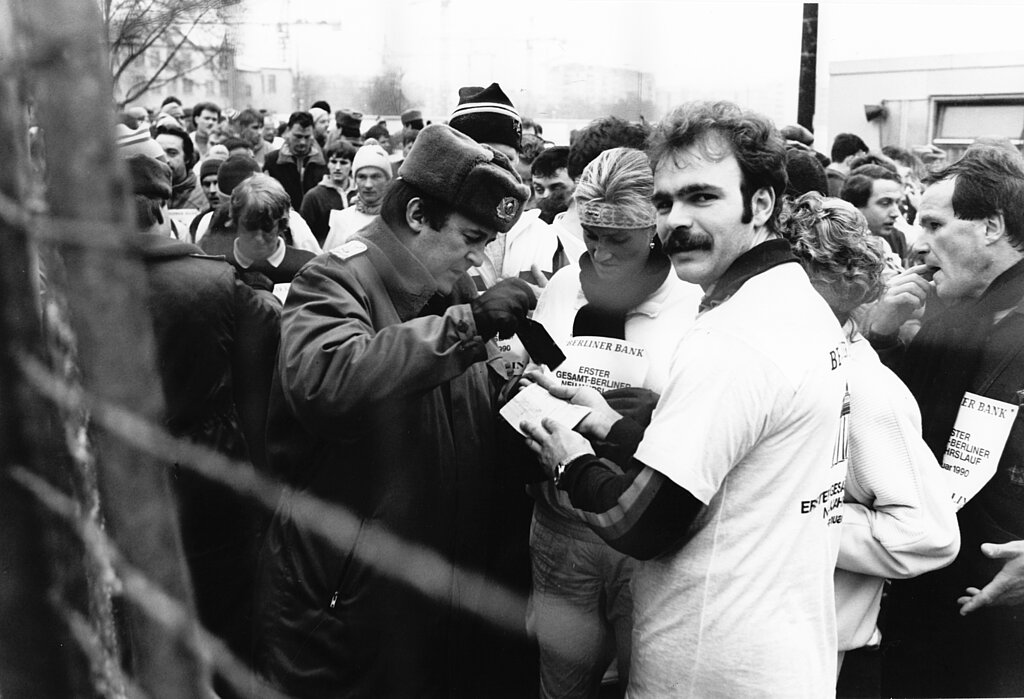
GDR border police officer stamps participants' race numbers with a pass stamp at the start of the 1990 New Year's Run © picture alliance / ZB / Manfred Uhlenhut
The Berlin New Year's Run is also a prime example of German-German sporting history. From its inception in 1972 and its development in the eastern part of divided Berlin to the thriller before the first all-Berlin New Year's Run in 1990 and the continuation of the success story after the fall of the Wall, it is a story that is typically Berlin.
From its foundation in 1972 to the fall of the Berlin Wall
In 1972, the GDR sports reporter legend Heinz Florian Oertel had the idea of calling for a New Year's run in Berlin. In the Olympic year, the runners were to take part in an informal. New Year's jog on the Olympic Mile. The premiere was a complete success. An estimated 3,000 participants gathered on New Year's Day at 11 a.m. at today's “Platz der Nationen” (then Lenin Square). Oertel, who died in 2023 at the age of 95, recalled after the premiere: “We were curious to see how the Berliners would react. Of course, we didn't use timekeeping, and with a distance of 1972 m, we didn't overtax anyone.”
Together with a run from Saxony, the Berlin edition was probably the first New Year's run in Germany. In the following years, up to 10,000 runners took part in the Berlin New Year's Run each year in Friedrichshain near the so-called Mont Klamott - a hill made of rubble (organized together with the The German Gymnastics and Sports Federation of the GDR [“DTSB”]). The record number of around 9,500 participants dates back to 1985. Traditionally, the runners received a green “participant ribbon” at the finish line.
Oertel became better known beyond the GDR. When Waldemar Cierpinski became Olympic champion in the marathon at the 1980 Olympic Games in Moscow for the second time in a row, Oertel called out on the GDR television broadcast: “Men, fathers - have courage: name your newborn sons Waldemar today”.
53 days from the fall of the Wall to the 1st All-Berlin New Year's Run
When the Wall came down in Berlin on November 9, 1989, a lot changed in social sports life in one fell swoop. The idea for an All-Berlin New Year's Run in 1990 came from the English Times journalist Michael Coleman one day after the fall of the Wall. On November 10, 1989, he called the then race director of the BERLIN MARATHON, Horst Milde, and suggested the idea of running from the Olympic Stadium through the Brandenburg Gate to the Rotes Rathaus on New Year's Day 1990. In the early phase of the post-reunification period, various people in charge, including from the DTSB in East Berlin and the Charlottenburg Sports Club in West Berlin, met to discuss the technical and organizational details of an all-Berlin New Year's run.
Together, a number of hurdles were overcome, such as the original demand of the East Berlin Police Headquarters for a passport stamp requirement for foreign participants crossing the allied “Checkpoint Charlie”. In the end, and many negotiations later, it was a sensation to announce the 1st Berlin New Year's Run in 1990, a good 50 days after the fall of the Wall. The start and finish were on the “Straße des 17. Juni”near the Brandenburg Gate. The route favored by the English journalist Coleman was not quite realized. It was a little too long for the short planning time.
The “double run” on New Year's Day 1990
On January 1, 1990, the 19th edition of the Berlin New Year's Run in Friedrichshain started at 11 am. A good 3,000 participants took to the starting line. At 2 p.m., around 25,000 runners from all over the world gathered to take part in the 1st Berlin New Year's Run. Governing Mayor Walter Momper (West Berlin) and Mayor Erhard Krack (East Berlin) gave the starting signal for the historic sporting event. The run through the Wall and between the pillars of the Brandenburg Gate to the Rotes Rathaus and back was an emotional and emotional experience.
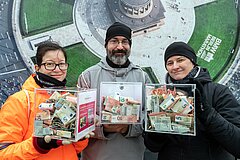
On the way back, the passport stamp requirement became a “stamping pleasure”. Many participants collected a stamp on their race number from the GDR border police. At the finish line, the runners received commemorative certificates. The organizers waived a participation fee. Instead, donations were collected for the children's charity UNICEF. The collection raised 12,696.37 Deutschmarks, which Berliner Bank rounded up to 13,000 Deutschmarks [“D-Mark”]. The collection boxes and tins contained not only D-Mark but also Ostmark, roubles and dollars - also a sign of internationality.
From anniversary to anniversary after reunification
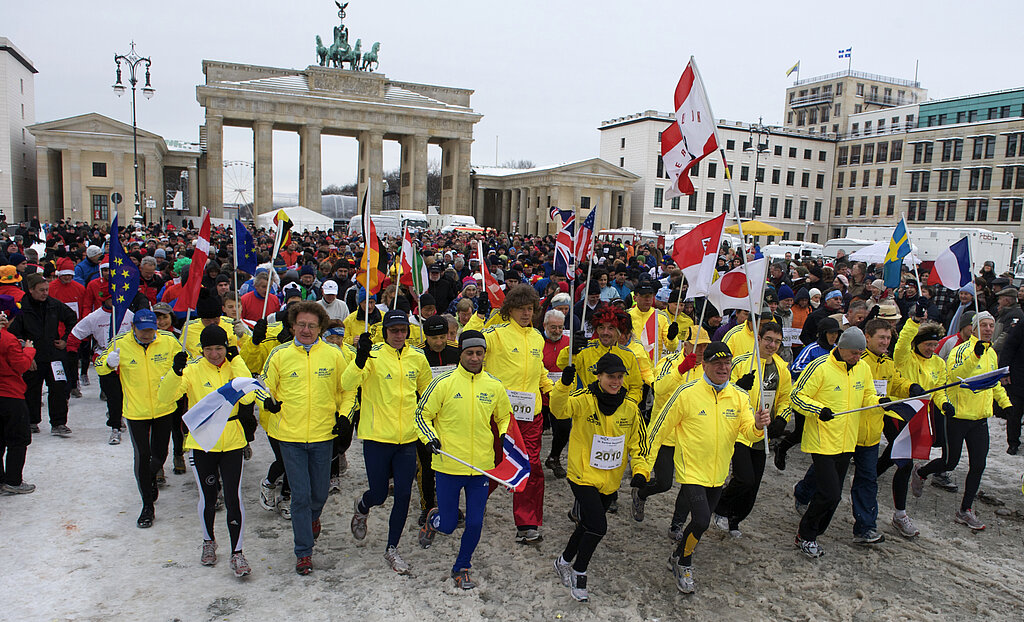
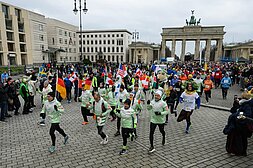
Participants in the last Berlin New Year's Run in the snow in 2010 ©SCC EVENTS / camera4
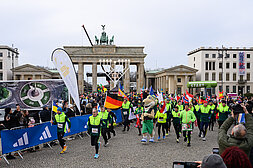
Heinz Florian Oertel and Horst Milde later agreed that the Berlin New Year's Run would subsequently take place exclusively in the center of Berlin in front of the Brandenburg Gate. In terms of sporting history, the two were to be brought together. For many years after 1990, Oertel could always be heard on the microphone on January 1 as the spokesperson for the run.
The starting gunners from politics and society did the honors at the Berlin New Year's Run. After the governing and Lord Mayors of West and East Berlin were active in 1990, the District Mayor of Berlin-Mitte, Joachim Zeller, took over the office for a long time.
Among the prominent starting shooters at the anniversary events were also Bundestag President Wolfgang Thierse and the correspondent of the ARD capital studio Werner Sonne as well as ambassadors of the charity organizations of UNICEF and the Björn Schulz Foundation.
No weather could stop the participants at the Berlin New Year's Run. Extreme cold or snow were no obstacles to the run for a good cause. The last significant snowfall was in 2010 at the 39th edition of the classic run. The new four-kilometre route of the Berlin New Year's Run has been well known for several years: from the Brandenburg Gate to Berlin Cathedral and back (Course map PDF).
Nevertheless, it took three attempts for the 50th anniversary of the Berlin New Year's Run. Due to the coronavirus pandemic, the organizers from SCC EVENTS unfortunately had to cancel the events in 2021 and 2022. The 50th edition could therefore only be celebrated in 2023. Unfortunately without Heinz Florian Oertel, the man who came up with the idea, who was unable to attend for health reasons.
Celebrities at the Berlin New Year's Run for a good cause
Among the 4,000 to 5,000 runners each year, there were always prominent participants - some of whom went undetected. The district mayor of Berlin-Mitte usually took the opportunity to join the runners after the starting signal, as did Werner Sonne (correspondent for the ARD capital studio). In 2001, the German Foreign Minister Joschka Fischer was spotted among the runners at the Berlin New Year's Run. Oscar winner Volker Schlöndorff, a running enthusiast, took part in the run at the start of the year in 2015. Cycling legend and multiple Tour de France participant Jens Voigt also took part in the 50th Berlin New Year's Run on the first day of the year. A regular guest on New Year's Day in recent years is politician and President of the Berlin Disabled and Rehabilitation Sports Association Özcan Mutlu from Bündnis 90/Die Grünen.
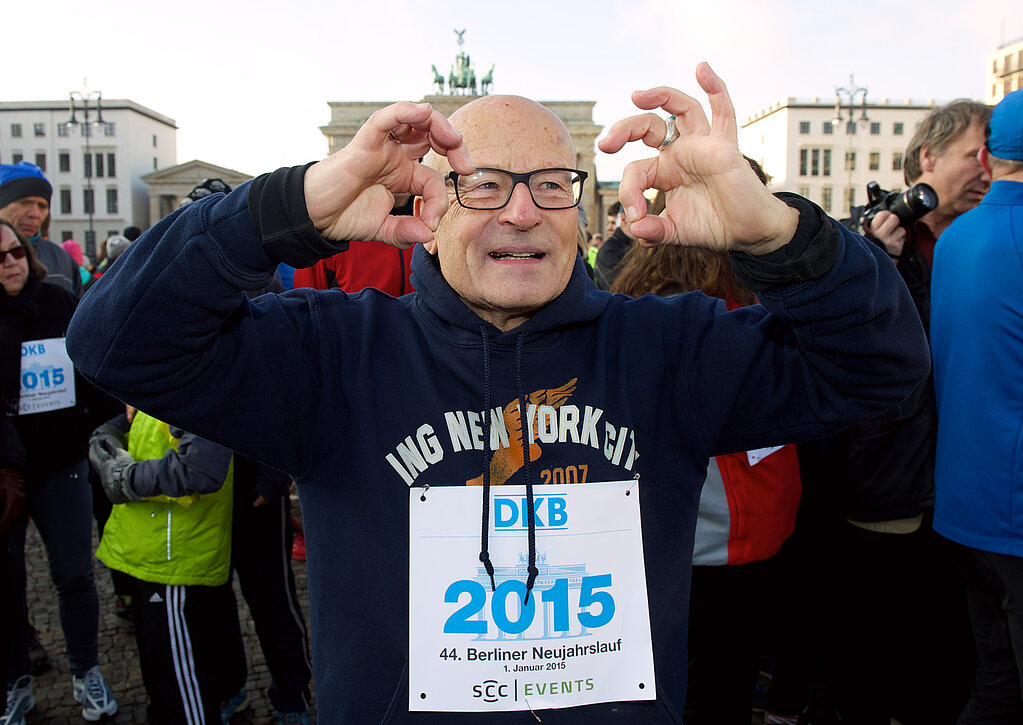
Oscar winner Volker Schlöndorff at the 2015 New Year's Run ©SCC EVENTS/camera4
All participants are united by running for a good cause. The charity tradition that the SCC has been practicing since 1990 at the Berlin New Year's Run still applies today. The waiver of participation fees frees up space for donations. Initially from 1990 to 2012 for the children's charity UNICEF and since then for the Björn Schulz Foundation. Runners who are unable to be at the Berlin New Year's Run on the first day of the year now also have the opportunity to participate in donations. It's easy with the online fundraising campaign.